Sunday, December 9, 2012

Edward Weston, Nude, 1925, Platinum Print, 71/2" X 91/2"


                                         Nude, 1925, Platinum Print, 71/2" X 91/2"
                                                                  -Edward Weston

 
Edward Henry Weston (March 24, 1886 - January 1, 1958) He began photographing at the age of 16 after receiving a Bull’s Eye #2 camera from his father. In 1908 Weston attended the Illinois College of Photography in Effingham, Illinois. He completed the 12-month course in six months and returned to California. Between 1927 and 1930, Weston made a series of monumental close-ups of seashells, peppers, and halved cabbages, bringing out the rich textures of their sculpture-like forms. In 1936 marked the start of Weston’s series of nudes and sand dunes in Oceano, California, which are often considered some of his finest pieces.


 "I am stimulated to work with the nude body, because of the infinite combinations of lines which are present with every move,"
                        -Edward Weston .
"Is love like art - something always ahead, never quite attained,"
-Edward Weston
“The camera should be used for a recording of life, for rendering the very substance and quintessence of the thing itself, whether it be polished steel or palpitating flesh.”
      -Edward Weston

This picture is abstract, in black and white showcasing the human body (only a portion) - making a great addition to my exhibit. 


Jean (Hans) ARP,Collage Arranged According to the Laws of Chance, 1916-1917. Torn and Pasted paper, 1' 7/8" X 1' 15/8"


Collage Arranged According to the Laws of Chance, 1916-1917. Torn and Pasted paper, 1' 7/8" X 1' 15/8"
                     -Jean Hans ARP

For this piece, Jean Hans dropped squares (torn out of paper) onto a sheet of paper and then glued them. 
Jean Hans (September 16 1887 – 1966) He was a sculptor, painter and poet. He Spent some time at the Julian Academy of Paris in 1908. After that, he went to Weggis, Switzerland, where he worked for some years in solitude. Co-founder of the Zürich DaDa movement in 1916. 

 " I allow myself to be guided by the work which is in the process of being born, I have confidence in it (automatic painting, fh). I do not think about it. The forms arrive pleasant, or strange, hostile, inexplicable, mute, or drowsy. They are born from themselves. It seems to me as if all I do is move my hands." 
          - Jean Hans ARP
 
This piece was created in a unique manner and gave art to the Dada movement. Something I feel fits in nicely with my exhibit. 

Kazimir (Kasimir) Malevich, Black Square, 1915, Oil on Canvas,106 x 106 cm

 Black Square, 1915, Oil on Canvas,106 x 106 cm
-Kazimir (Kasimir) Malevich
The Black Square is one of the most famous creations of Russian art in the last century. The first Black Square was painted in 1915 to become the turning point in the development of Russian avant-garde.
Black Square against white background became the symbol, the basic element in the system of the art of suprematism, the step into the new art.

Kazimir Malevich (February 23 1879 – May 15 1935) was a Russian painter and art theoretician. He was a pioneer of geometric abstract art and the originator of the avant-garde Suprematism movement.In 1915, Malevich laid down the foundations of Suprematism. He published his manifesto From Cubism to Suprematism. Malevich became a member of the Collegium on the Arts of Narkompros, the commission for the protection of monuments and the museums commission (all from 1918–1919).
 "Hence, to the Suprematist, the appropriate means of representation is always the one which gives fullest possible expression to feeling as such and which ignores the familiar appearance of objects.
Objectivity, in itself, is meaningless to him; the concepts of the conscious mind are worthless. Feeling is the determining factor ... and thus art arrives at non objective representation at Suprematism...Everything which determined the objective ideal structure of life and of "art' ideas, concepts, and images all this the artist has cast aside in order to heed pure feeling... Suprematism is the rediscovery of pure art which, in the course of time, had become obscured by the accumulation of "things".

This piece became a staple for a huge movement, and something many people only hoped to accomplish with their own art. Making it a perfect addition to my exhibit

Kazimir (Kasimir) Malevich, Suprematism with Blue Triangle and Black Square,1915 ,oil on canvas, 26.2" × 22.4"

             Suprematism with Blue Triangle and Black Square,1915 ,oil on canvas, 26.2" × 22.4"
                                                                                   -Kazimir (Kasimir) Malevich


Kazimir Malevich (February 23 1879 – May 15 1935) was a Russian painter and art theoretician. He was a pioneer of geometric abstract art and the originator of the avant-garde Suprematism movement.In 1915, Malevich laid down the foundations of Suprematism. He published his manifesto From Cubism to Suprematism. Malevich became a member of the Collegium on the Arts of Narkompros, the commission for the protection of monuments and the museums commission (all from 1918–1919).
 "Hence, to the Suprematist, the appropriate means of representation is always the one which gives fullest possible expression to feeling as such and which ignores the familiar appearance of objects.
Objectivity, in itself, is meaningless to him; the concepts of the conscious mind are worthless. Feeling is the determining factor ... and thus art arrives at non objective representation at Suprematism...Everything which determined the objective ideal structure of life and of "art' ideas, concepts, and images all this the artist has cast aside in order to heed pure feeling... Suprematism is the rediscovery of pure art which, in the course of time, had become obscured by the accumulation of "things."


This piece shows that such a big statement can be made from minimal shapes and colors.

Josef Albers, Homage To the Square: "Ascending", 1953. Oil On Composition board, 3' 71/2" X 3' 71/2"

  Homage To the Square: "Ascending", 1953. Oil On Composition board, 3' 71/2" X 3' 71/2" 
                                                                   -Josef Albers

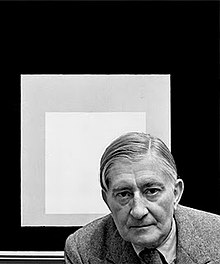
Josef Albers has painted hundred of canvases with the same composition but in different hues, value and saturation all to show the instability and relativity of color perception. He explained his motivation:
  "They (the colors) are juxtaposed for various and changing visual effects... Such actions, reaction, interaction...is sought in order to make obvious how colors influence and change each other; that the same color, for instance-with different grounds or neighbors-looks different...Such color deceptions prove that we see colors almost ever unrelated to each other."

 Josef Albers (March 19, 1888 – March 25, 1976) was a German (born) American artist and educator whose work, both in Europe and in the United States, formed the basis of some of the most influential and far-reaching art education programs of the 20th century. He worked as a school teacher from 1908 to 1913. In 1918 he received his first public commission, Rosa mystica ora pro nobis, a stained-glass window for a church. He studied art in Berlin, Essen, and Munich, before enrolling as a student at the prestigious Weimar Bauhaus in 1920. The director and founder of the Bauhaus, Walter Gropius, asked him in 1923 to teach then in 1925, Albers was promoted to Professor. 


This piece uses one primary shape and 4 colors, but invokes great thought along with the realization of color relationships and tonal value - making it a great addition to the exhibit. 

Jack-in-the-Pulpit No. 4, 1930 Oil On Canvas 3' 4" X 2' 6" By Georgia O'Keefe

                                 Jack-in-the-Pulpit No. 4, 1930 Oil On Canvas 3' 4" X 2' 6" 
                                                               -Georgia O'Keeffe
This beautiful abstract piece is the inside and extremely close up view of a flower. The darkness is surrounded by a halo of light, playing off of the shapes of the petals while enhancing the color and adding depth to the darkness. This is a piece from a series of 6 paintings, each one increasing in detail.

Robertson calls O'Keefe's Jack-in-the-Pulpit series "O'Keeffe's most complete statement of the relationship between abstraction and representation."
       
   O’Keeffe (Nov. 15, 1887,- March 6, 1986,) She studied art in Chicago and New York City. By the early 1920s, her highly individualistic painting style had emerged. Her subjects were often enlarged views of the skulls and other bones of animals, flowers and plant organs, shells, rocks, mountains, and other natural forms. Her mysteriously suggestive images of bones and flowers set against a perspective less space have inspired a variety of erotic, psychological, and symbolic interpretations. She is regarded by critics as one of the most original and important American artists. 


 “It is surprising to me to see how many people separate the objective from the abstract. Objective painting is not good painting unless it is good in the abstract sense. A hill or tree cannot make a good painting just because it is a hill or a tree. It is lines and colors put together so that they say something. For me that is the very basis of painting. The abstraction is often the most definite form for the intangible thing in myself that I can only clarify in paint.”
“I long ago came to the conclusion that even if I could put down accurately the thing that I saw and enjoyed, it would not give the observer the kind of feeling it gave me. I had to create an equivalent for what I felt about what I was looking at – not copy it.”
                       -Georgia O’Keeffe, 1976


 This piece was added to my exhibition because of the simplicity of design,  abstract quality and use of very few colors. With its nature depiction and use of abstract form I found it to be a great addition to my gallery of art. 

Saturday, December 8, 2012

Conclusion


   During this process I organized artists according to theme and found it rather enjoyable, finding similarities through different time periods, countries and media types. It took some time and  careful process but I think it all came together rather nicely. The theme came to me pretty easily, I found myself enjoying more simplistic pieces compared to the more complex - the amount of thought and feelings towards any of these pieces can be so vastly different from person to person that I find it more interesting than the pieces (at times).

    As curator I feel the job was very interesting and thought provoking, I think at least it is a good example of  my tastes and the way art speaks to me, and how it has changed and yet stayed the same throughout history.  Art is a wonderful source of stirring up controversy, thought, and even conversation. From a simple square, color, brush stroke so much can be created!
         
            "If you hear a voice within you say 'you cannot paint,' then by all means paint, and that voice will be silenced."
         Vincent Van Gogh
                                                  "A picture is worth a thousand words."
                                                                Napoleon Bonaparte

"Creativity is allowing yourself to make mistakes. Art is knowing which ones to keep."
            Scott Adams